Mr. Wadge's Math Shack
  • Welcome
  • Grade 12 Courses
    • Calculus 12 >
      • Projects
      • Ch 0: PreCalculus Review >
        • 0.0 One-Day Review
        • 0.1 PreCalculus Review (part 1)
        • 0.2 PreCalculus Review (part 2)
        • 0.3 PreCalculus Review (part 3)
        • 0.4 PreCalculus Review (part 4)
        • 0.5 PreCalculus Review (part 5)
      • Ch 1 Limits and Rates of Change >
        • 1.1 & 1.2 Tangent Problem / Limit of a Function
        • 1.3 One-Sided Limits
        • 1.3 (part 2) Intermediate Value Theorem
        • 5.1 Vertical Asymptotes
        • 5.2 Horizontal Asymptotes
        • 1.4 Using Limits to Find Tangents
        • 1.5 Velocity and Other Rates of Change
        • 1.8 Review Exercises / 1.9 Chapter Test
      • Ch 2 Derivatives >
        • 2.1 Derivatives
        • 2.2 The Power Rule
        • 2.3 The Sum and Difference Rules
        • 2.4 The Product Rule
        • 2.5 The Quotient Rule
        • 2.6 The Chain Rule
        • 2.7 Implicit Differentiation
        • 2.8 Higher Derivatives
        • 2.9 Review Exercises / 2.10 Chapter Test
      • Ch 3 Applications of Derivatives >
        • 3.1 Velocity
        • 3.2 Acceleration
        • 3.3 Rates of Change in the Natural Sciences
        • 3.5 Related Rates
        • 3.6 Newton's Method
        • BONUS: Local Linear Approximation
        • 3.7 Review Exercises / 3.8 Chapter Test
      • Ch 4 Extreme Values >
        • 4.1 Increasing and Decreasing Functions (part 1 of 2)
        • 4.1 Increasing and Decreasing Functions (part 2 of 2)
        • 4.2 Maximum and Minimum Values
        • 4.0 Existence Theorems
        • 4.3 The First Derivative Test
        • 4.4 Applied Maximum and Minimum Problems (part 1 of 2)
        • 4.4 Applied Maximum and Minimum Problems (part 2 of 2)
        • 4.6 Review Exercises / 4.7 Chapter Test
      • Ch 5 Curve Sketching >
        • 5.0 Review
        • 5.3 Concavity and Points of Inflection
        • 5.4 The Second Derivative Test
        • 5.5 A Procedure For Curve Sketching (part 1 of 2)
        • 5.5 A Procedure For Curve Sketching (part 2 of 2)
        • 5.6 Slant Asymptotes
        • 5.7 Review Exercises / 5.8 Chapter Test
      • Ch 6 Trigonometry Review >
        • 6.0 Review (part 1)
        • 6.0 Review (part 2)
        • 6.0 Review (part 3)
      • Ch 7 Derivatives of Trigonometric Functions >
        • 7.1 Limits of Trigonometric Functions
        • 7.2 Derivatives of the Sine and Cosine Functions (part 1 of 2)
        • 7.2 Derivatives of the Sine and Cosine Functions (part 2 of 2)
        • 7.3 Derivatives of Other Trigonometric Functions
        • 7.4 Applications
        • 7.5 Inverse Trigonometric Functions (part 1 of 2)
        • 7.5 Inverse Trigonometric Functions (part 2 of 2)
        • 7.6 Derivatives of the Inverse Trigonometric Functions
        • 7.7 Review Exercises / 7.8 Chapter Test
      • Ch 8 Exponential and Logarithmic Functions >
        • 8.1 Exponential Functions
        • 8.2 Derivatives of Exponential Functions
        • 8.0 Review of Logarithms
        • 8.3 Logarithmic Functions
        • 8.4 Derivatives of Logarithmic Functions
        • 8.6 Logarithmic Differentiation
        • BONUS: Indeterminate Forms and L'Hôpital's Rule
        • 8.7 Review Exercises / 8.8 Chapter Test
      • Ch 9 Area Under Curves >
        • 9.1 Riemann Sums
        • 9.2 The Trapezoidal Rule
        • 9.3 Sigma Notation
        • 9.4 Limit of Riemann Sums
      • Ch 10 Integration >
        • 10.1 Antiderivatives
        • 10.2 The Fundamental Theorem of Calculus
        • 10.3 The Substitution Rule
        • 10.4 Integration by Parts
      • Ch 11 Applications of Integrals >
        • 11.1 The Average Value Theorem
        • 11.2 Volume of Rotational Solids
        • 11.3 Volume of Rotational Solids (part 2)
        • 11.4 Volume of Rotational Solids (part 3)
        • 11.5 Differential Equations
        • 11.6 Slope Fields
      • Ch 12 Cumulative Review >
        • 12.1 Cumulative Review for Chapters 1 – 3
        • 12.2 Cumulative Review for Chapters 4 – 7
        • 12.3 Cumulative Review for Chapters 8 – 9
    • PreCalculus 12 >
      • Term Project Options
      • Review of Grade 11
      • Chapter 1: Sequence and Series >
        • 1.1 Arithmetic Sequences
        • 1.2 Arithmetic Series
        • 1.3 Geometric Sequences
        • 1.4 Geometric Series
        • 1.5 Infinite Geometric Series
        • 1.6 Chapter Review
      • Ch2: Transformations (First Half) >
        • 2.1 Functions and Relations (review)
        • 2.2 Arithmetic Combinations of Functions
        • 2.3 Composite Functions
        • 2.5 Inverse Functions (Part 1 of 2)
        • 2.5 Inverse Functions (Part 2 of 2)
        • 2.7 Chapter Review
      • Ch2: Transformations (Second Half) >
        • 2.4 Transformations of Graphs (Part 1 of 2)
        • 2.4 Transformations of Graphs (Part 2 of 2)
        • 2.6 Combined Transformations
        • 2.7 Chapter Review
      • Ch3: Polynomials >
        • 3.1 Polynomials
        • 3.2 Graphing Polynomial Functions
        • 3.3 Division of Polynomials
        • 3.4 The Remainder and Factor Theorems
        • 3.5 Polynomial Applications
        • 3.6 Chapter Review
      • Ch4: Radicals & Rational Functions >
        • 4.1 Radicals
        • 4.2 Graphing and Solving Radical Equations
        • 4.3 Rational Functions
        • 4.4 Graphing Rational Functions
        • 4.5 Chapter Review
      • Ch5: Logarithms >
        • 5.1 Exponents
        • 5.2 Logarithmic Functions and their Graphs (Part 1 of 2)
        • 5.2 Logarithmic Functions and their Graphs (Part 2 of 2)
        • 5.3 Properties of Logarithms
        • 5.4 Exponential and Logarithmic Equations
        • 5.5 Applications of Exponential and Logarithmic Functions
        • 5.6 Chapter Review
      • Ch6: Trigonometry (Pt. 1) >
        • 6.1 Angles and their Measure
        • 6.2 Trigonometric Functions of Acute Angles
        • 6.3 Trigonometric Function - General & Special Angles
        • 6.4 Graphing Basic Trigonometric Functions (part 1 of 3)
        • 6.4 Graphing Basic Trigonometric Functions (part 2 of 3)
        • 6.4 Graphing Basic Trigonometric Functions (part 3 of 3)
        • 6.5 Application of Periodic Functions
        • 6.6 Chapter Review
      • Ch7: Trigonometry (Pt. 2) >
        • 7.1 Trigonometric Identities and Equations
        • 7.2 Verifying Trigonometric Identities
        • 7.3 Trigonometric Equations (part 1 of 2)
        • 7.3 Trigonometric Equations (part 2 of 2)
        • 7.4 Sum and Difference Identities (part 1 of 2)
        • 7.4 Sum and Difference Identities (part 2 of 2)
        • 7.5 Double Angle Identities
        • 7.6 Chapter Review
      • Old Curriculum Material >
        • 7.1 Fundamental Counting Principle (part 1 of 2)
        • 7.1 Fundamental Counting Principle (part 2 of 2)
        • 7.2 Permutations
        • 7.3 Combinations
        • 7.4 Binomial Theorem
        • 7.5 Pathway Problems
        • 7.6 Chapter Review
      • Final Exam
    • Foundations 12 >
      • Ch 1: Logical Reasoning and Set Theory >
        • 1.1 Connecting Words "And", "Or", "Not"
        • 1.2 Set Theory (Part 1 of 2)
        • 1.2 Set Theory (Part 2 of 2)
        • 1.3 Venn Diagrams - Part One
        • 1.4 Venn Diagrams - Part Two
        • 1.5 Conditional Statements
        • 1.6 Chapter Review
      • Ch 2: Permutations and Combinations >
        • 2.1 The Fundamental Counting Principle (part 1 of 2)
        • 2.1 The Fundamental Counting Principle (part 2 of 2)
        • 2.2 Factorial Notation and Permutations (part 1 of 2)
        • 2.2 Factorial Notation and Permutations (part 2 of 2)
        • 2.3 Permutations with Restrictions
        • 2.4 Permutations with Repetitions
        • 2.5 Combinations - Part 1
        • 2.6 Combinations - Part 2
        • 2.7 Problem Solving with Permutations and Combinations
        • 2.8 Chapter Review
      • Ch 3: Probability >
        • 3.1 Probability Terminology and Notation
        • 3.2 Odds and Probability
        • 3.3 Mutually Exclusive Events and the Event "A ∪ B"
        • 3.4 Independent / Dependent Events and the Event "A ∩ B"
        • 3.5 Solving Problems Using Tables and Diagrams
        • 3.6 Probability Involving Permutations and Combinations
        • 3.7 Chapter Review
      • Ch 4: Exponential and Logarithmic Functions >
        • 4.1 Review and Preview (part 1 of 2)
        • 4.1 Review and Preview (part 2 of 2)
        • 4.2 Analyzing Exponential Functions (part 1 of 2)
        • 4.2 Analyzing Exponential Functions (part 2 of 2)
        • 4.3 Analyzing Logarithmic Functions (part 1 of 2)
        • 4.3 Analyzing Logarithmic Functions (part 2 of 2)
        • 4.4 Interpreting Graphs of Exponential and Logarithmic Functions
        • 4.5 Modelling Data Using Exponential and Logarithmic Functions
        • 4.6 Chapter Review
      • Ch 5: Polynomial and Sinusoidal Functions >
        • 5.1 Polynomial Functions of Degree Zero, One, and Two
        • 5.2 Polynomial Functions of Degree Three
        • 5.3 Modelling Data Using Polynomial Functions
        • 5.4 Angular Measure - Degrees and Radians (part 1 of 2)
        • 5.4 Angular Measure - Degrees and Radians (part 2 of 2)
        • 5.5 Amplitude and Period
        • 5.6 Horizontal & Vertical Shifts
        • 5.7 Modelling Data Using Sinusoidal Functions
        • 5.8 Chapter Review
      • Ch 6: Financial Mathematics >
        • 6.1 Simple Interest andCompound Interest
        • 6.2 Investments Using Compound Interest
        • 6.3 Basic Loans Using Compound Interest (part 1 of 2)
        • 6.3 Basic Loans Using Compound Interest (part 2 of 2)
        • 6.4 Mortgages
        • 6.5 Buying, Renting, and Leasing
        • 6.6 Investment Portfolios
        • 6.7 Chapter Review
  • Grade 11 Classes
    • PreCalculus 11 >
      • Review (what you should already know)
      • Ch1: Factoring and the Quadratic Function >
        • 1.1 Factoring
        • 1.2 Factoring (More Complicated Types)
        • 1.3 Properties of Quadratic Functions
        • 1.4 The Standard Form of a Quadratic Function
        • 1.5 Chapter Review
      • Ch2: Quadratic Transformations >
        • 2.1 Finding the Equation of a Parabola
        • 2.2 General Form to Standard Form
        • 2.3 Vertex of a Parabola
        • 2.4 Applications of Quadratic Functions
        • 2.5 Chapter Review
      • Ch3: Quadratic Equations >
        • 3.1 Solving Quadratic Equations by Factoring
        • 3.2 Completing the Square and Square Root Property
        • 3.3 The Quadratic Formula
        • 3.4 Graphing Calculator and the Discriminant
        • 3.5 Applications of Quadratic Equations
        • 3.6 Chapter Review
      • Ch4: Systems of Equations >
        • 4.1 Graphing Non-Linear Systems of Equations
        • 4.2 Solving Non-Linear Systems Algebraically
        • 4.3 Graphing Linear Inequalities in Two Variables
        • 4.4 Graphing Non-Linear Inequalities
        • 4.5 Applications of Inequalities
        • 4.6 Chapter Review
      • Ch5: Radicals >
        • 5.1 Radical Operations (Part 1 of 2)
        • 5.1 Radical Operations (Part 2 of 2)
        • 5.2 Simplifying Radicals
        • 5.3 Adding and Subtracting Radical Expressions
        • 5.4 Multiplying and Dividing Radical Expressions (Part 1 of 2)
        • 5.4 Multiplying and Dividing Radical Expressions (Part 2 of 2)
        • 5.5 Radical Equations
        • 5.6 Chapter Review
      • Ch6: Rational Functions >
        • 6.1 Properties of Rational Expressions
        • 6.2 Multiplication and Division of Rational Expressions
        • 6.3 Sums and Differences of Rational Expressions
        • 6.4 Mixed Operations
        • 6.5 Rational Equations
        • 6.6 Graphing Rational Functions
        • 6.7 Applications of Rational Equations
        • 6.8 Chapter Review
      • Ch7: Trigonometry >
        • 7.1 Angles and their Measure
        • 7.2 The Three Trigonometric Functions
        • 7.3 Special Angles
        • 7.4 & 7.5 Oblique Triangles / Law of Sines (Part 1)
        • 7.5 Law of Sines (Part 2)
        • 7.6 Law of Cosines
        • 7.7 Chapter Review
      • Ch8: Finance >
        • 8.1 Investments and Loans
        • 8.2 Effective Interest Rates and Annuities
        • 8.3 Stocks and Bonds
        • 8.4 Instalment Loans
        • 8.5 Canadian Mortgages
        • 8.6 Chapter Review
      • Final Exam Review
      • Old Curriculum Material >
        • 1.1 Absolute Value
        • 4.3 Absolute Value Functions
        • 4.4 Solving Absolute Value Equations
        • 4.5 Rational Functions
        • 4.6 Reciprocal Functions (Part 1 of 2)
        • 4.6 Reciprocal Functions (Part 2 of 2)
        • 4.7 Chapter Review
    • Foundations 11 >
      • Ch 1: Rates and Scale Factor >
        • 1.1 Ratios and Rates
        • 1.2 Visualizing Rates
        • 1.3 Similar Figures
        • 1.4 Perimeter, Area and Surface Area of Similar Figures
        • 1.5 Volume of Similar Figures
        • 1.6 Chapter Review
      • Ch 2: Geometry >
        • 2.1 Geometry
        • 2.2 Proofs
        • 2.3 Polygons
        • 2.4 Compass and Straightedge Construction
        • 2.5 Chapter Review
      • Ch 3: Non-Right Angle Triangles >
        • 3.1 Review of Sine, Cosine and Tangent for Right Triangles
        • 3.2 Law of Sines (Part 1 of 2)
        • 3.2 Law of Sines (Part 2 of 2)
        • 3.3 Law of Cosines
        • 3.4 Applied Problems
        • 3.5 Chapter Review
      • Ch 4: Analyze Puzzles and Games >
        • 4.1 Patterns
        • 4.2 Inductive Reasoning
        • 4.3 Deductive Reasoning
        • 4.4 Puzzles and Games of Strategy
        • 4.5 Chapter Review
      • Ch 5: Statistics >
        • 5.1 Mean, Median and Mode
        • 5.2 Standard Deviation
        • 5.3 The Normal Distribution (Part 1 of 2)
        • 5.3 The Normal Distribution (Part 2 of 2)
        • 5.4 Confidence Interval for Means
        • 5.5 Chapter Review
      • Ch 6: Linear Systems >
        • 6.1 Review: Graphing a Linear Equation (Part 1 of 2)
        • 6.1 Review: Graphing a Linear Equation (Part 2 of 2)
        • 6.2 Linear Inequalities
        • 6.3 Linear Programming
        • 6.4 Application of Linear Programming
        • 6.5 Chapter Review
      • Ch 7: Quadratic Functions >
        • 7.1 Quadratic Functions (Part 1 of 3)
        • 7.1 Quadratic Functions (Part 2 of 3)
        • 7.1 Quadratic Functions (Part 3 of 3)
        • 7.2 General Form of a Quadratic Function
        • 7.5 Application of Quadratic Functions & Equations (part 1 of 2)
        • 7.0 Graphing Non-Linear Systems of Equations (Part 1 of 2)
        • 7.0 Graphing Non-Linear Systems of Equations (Part 2 of 2)
        • 7.6 Chapter Review
      • Ch8: Math Research Project
      • Old Curriculum Material >
        • 7.3 Quadratic Equations
        • 7.4 Solving Quadratic Equations (part 1 of 2)
        • 7.4 Solving Quadratic Equations (part 2 of 2)
        • 7.5 Application of Quadratic Functions & Equations (part 2 of 2)
    • Workplace 11 >
      • Ch 1: Slope and Rate of Change >
        • 1.1 Ratios and Proportions
        • 1.2 Rates / Solving Problems with Proportions
        • 1.3 Slope
        • 1.4 Angle of Elevation
        • 1.5 Pitch, Grade, and Drop
        • 1.6 Calculating Slope on a Coordinate Plane
        • 1.7 Calculating Slope from Ordered Pairs
        • 1.8 Rate of Change
        • 1.9 Interpolation and Extrapolation
      • Ch 2: Graphs and Statistics >
        • 2.1 Broken Line Graphs
        • 2.2 Bar Graphs
        • 2.3 Pictographs
        • 2.4 Histograms
        • 2.5 Review of Percents / Circle Graphs ​(part 1 of 2)
        • 2.5 Making Circle Graphs (part 2 of 2)
        • 2.6 Graphs and Technology
        • 2.7 Other Types of Graphs
        • 2.8 Misleading Graphs
        • 2.9 Mean, Median, Mode, and Range
        • 2.10 Standard Deviation
      • Ch 3: Scale Factor and Representations >
        • 3.1 Scale Factor
        • 3.2 Scale Diagrams
        • 3.3 One-Point Perspective
        • 3.4 Two-Point Perspective
        • 3.5 Exploded Views and Component Parts
        • 3.6 Orthographic Drawings
        • 3.7 Isometric Drawings
        • 3.8 Oblique Drawings
      • Ch 4: Financial Literacy >
        • 4.1 Financial Institutions
        • 4.2 Bank Accounts
        • 4.3 Bank Statements
        • 4.4 Simple Interest
        • 4.5 Compound Interest
        • 4.6 Compounding Periods
        • 4.7 Credit
        • 4.8 Loans
        • 4.9 Mortgages
        • 4.10 Mortgage Payments
        • 4.11 Investments
  • Grade 8, 9, 10 Classes
    • Foundations & PreCalculus 10 >
      • Problem Sets
      • Review (what you should already know)
      • Ch 1: Measuring Systems, Surface Area, and Volume >
        • 1.1 Metric Systems
        • 1.2 Imperial Systems
        • 1.3 Converting Metric and Imperial Systems
        • 1.4 Surface Area and Volume of Prisms (part 1 of 2)
        • 1.4 Surface Area and Volume of Prisms (part 2 of 2)
        • 1.5 Surface Area and Volume of Pyramids
        • 1.6 Surface Area and Volume of Cylinders, Cones, and Spheres
        • 1.7 Chapter Review
      • Ch 2: Radicals >
        • 2.1 Number Systems
        • 2.2 Greatest Common Factor and Least Common Multiple (part 1 of 2)
        • 2.2 Greatest Common Factor and Least Common Multiple (part 2 of 2)
        • 2.3 Squares and Square Roots
        • 2.4 Rational And Irrational Numbers
        • 2.5 Simplifying Radicals
        • 2.6 Exponential Notation (part 1 of 3)
        • 2.6 Exponential Notation (part 2 of 3)
        • 2.6 Exponential Notation (part 3 of 3)
        • 2.7 Chapter Review
      • Ch 3: Polynomials >
        • 3.1 Classifying Polynomials (part 1 of 2)
        • 3.1 Classifying Polynomials (part 2 of 2)
        • 3.2 Multiplying Polynomials
        • 3.3 Removing Common Factors
        • 3.4 Factoring x^2 + bx + c (part 1 of 2)
        • 3.4 Factoring x^2 + bx + c (part 2 of 2)
        • 3.5 Factoring ax^2 + bx + c
        • 3.6 Special Factors
        • Algebra Tiles
        • 3.7 Chapter Review
      • Ch 4: Relations and Functions >
        • 4.1 Relations
        • 4.2 Functions
        • 4.3 Linear Equations
        • 4.4 Non-Linear Equations
        • 4.5 Graphing with a Calculator
        • 4.6 Chapter Review
      • Ch 5: Linear Functions >
        • 5.1 Slope
        • 5.2 Rate of Change
        • 5.3 Graphing Linear Functions
        • 5.4 Parallel and Perpendicular Lines
        • 5.5 Applications of Linear Relations
        • 5.6 Chapter Review
      • Ch 6: Linear Equations >
        • 6.0 Rewriting Equations
        • 6.1 Different Forms of Linear Equations (part 1 of 2)
        • 6.1 Different Forms of Linear Equations (part 2 of 2)
        • 6.2 Special Cases of Linear Equations
        • 6.3 Equations of Parallel and Perpendicular Lines
        • 6.4 Linear Applications and Modelling
        • 6.5 Function Notation
        • 6.6 Chapter Review
      • Ch 7: Solving Linear Systems >
        • 7.1 Solving Linear Systems by Graphing
        • 7.2 Solving Linear Systems by Addition
        • 7.3 Solving Linear Systems by Substitution
        • 7.4 Problem Solving with Two Variables
        • 7.5 Chapter Review
      • Ch 8: Trigonometry >
        • 8.1 Sine, Cosine, and Tangent for Right Triangles (part 1 of 2)
        • 8.1 Sine, Cosine, and Tangent for Right Triangles (part 2 of 2)
        • 8.2 Relationships Between Sine, Cosine, and Tangent
        • 8.3 Special Angles
        • 8.4 Applications of Trigonometry
        • 8.5 Compound Trigonometry Applications
        • 8.6 Chapter Review
    • Math 9 >
      • Ch 1: Square Roots, Powers, and Exponent Laws >
        • 1.1 Square Roots
        • 1.2 Square Roots of Big & Small Numbers
        • 1.3 Estimating Square Roots
        • 1.4 Powers
        • 1.5 Order of Operations
        • 1.6 Exponent Rules
        • 1.7 Power Rules
        • 1.8 Review
      • Ch 2: Finance >
        • 2.1 Salary and Wages
        • 2.2 Commission
        • 2.3 Tips and Piecework
        • 2.4 Deductions
        • 2.5 Simple Interest
        • 2.6 Budgeting
      • Ch 3: Rational Numbers >
        • 3.1 Rational Numbers
        • 3.2 Operations with Integers
        • 3.3 Operations with Decimals
        • 3.4 Dividing Decimals
        • 3.5 Multiplying and Dividing Fractions
        • 3.6 Adding Fractions
        • 3.7 Subtracting Fractions
        • 3.8 Adding and Subtracting Negative Rational Numbers
        • 3.9 Order of Operations with Rational Numbers
        • 3.10 Review
      • Ch 4: Polynomials >
        • 4.1 Defining Polynomials
        • 4.2 Simplifying Polynomials
        • 4.3 Adding & Subtracting Polynomials
        • 4.4 Multiplying Polynomials
        • 4.5 Dividing Polynomials
        • 4.6 Order of Operations with Polynomials
      • Ch 5: Linear Equations >
        • 5.1 One-Step Equations
        • 5.2 Two-Step Equations
        • 5.3 Using the Distributive Property
        • 5.4 Combining Like Terms
        • 5.5 Variables on Both Sides of an Equation
        • 5.6 Clearing Fractions
        • 5.7 Solving ANY Linear Equation
        • 5.8 Writing Algebraic Equations
      • Ch 6: Proportional Reasoning >
        • 6.1 Congruent Triangles
        • 6.2 Similar Triangles (Part 1 of 2)
        • 6.2 Similar Triangles (Part 2 of 2)
        • 6.3 Similar Polygons
        • 6.4 Scale Factor
        • 6.5 Scale Diagrams
        • 6.6 Unit Conversions
      • Ch 7: Statistics >
        • 7.1 Statistics
      • Ch 8: Linear Relations >
        • 8.1 Patterns (part 1 of 2)
        • 8.1 Patterns (part 2 of 2)
        • 8.2 Modeling Real-Life Situations
        • 8.3 Cartesian Plane
        • 8.4 Graphing a Table of Values
        • 8.5 Interpolation and Extrapolation
    • Math 8 >
      • Ch 1: Integers >
        • 1.1 Multiplying Integers
        • 1.2 Dividing Integers
        • 1.3 Adding Integers
        • 1.4 Subtracting Integers
        • Practice
      • Ch 2: Fractions >
        • 2.1 Basic Fraction Skills
        • 2.2 More Fraction Skills
        • 2.3 Multiplying Fractions
        • 2.4 Multiplying Mixed Fractions
        • 2.5 Dividing Fractions
        • 2.6 Dividing Mixed Fractions
        • 2.7 Adding and Subtracting Fractions
        • 2.8 Adding Mixed Fractions
        • 2.9 Subtracting Mixed Fractions
        • 2.10 Order of Operations with Fractions
        • Practice
      • Ch 3: Percent, Proportions, Ratio, and Rate >
        • 3.1 Converting Fractions, Decimals, & Percents
        • 3.2 Solving Proportions
        • 3.3 Percents
        • 3.4 Common Percent Problems
        • 3.5 Ratios
        • 3.6 Rates
        • 3.7 Proportion Problems
        • Handouts
      • Ch 4: Square Roots and the Pythagorean Theorem >
        • 4.1 Perfect Squares and Square Roots
        • 4.2 Estimating Square Roots
        • 4.3 Cube and Cube Roots
        • 4.4 The Pythagorean Theorem
        • 4.5 The Pythagorean Theorem (continued)
        • 4.6 Applications of the Pythagorean Theorem
        • Practice
      • Ch 5: Probability and Statistics >
        • 5.1 Probability
        • 5.2 Probability with Cards
        • 5.3 Tree Diagrams
        • 5.4 Independent and Dependent Events
        • 5.5 Dependent Events
        • 5.6 Measures of Central Tendency
      • Ch 6: Linear Equations and Relations >
        • 6.1 Algebraic Expressions
        • 6.2 Solving One-Step Equations
        • 6.3 Solving Two-Step Equations
        • 6.4 The Distributive Property
        • 6.5 The Cartesian Plane
        • 6.6 Linear Relations
        • 6.7 Linear Models
      • Ch 7: Geometry >
        • 7.1 Area Review
        • 7.2 Area of Composite Shapes
        • 7.3 Volume of Prisms
        • 7.4 Volume of Composite Shapes
        • 7.5 Surface Area of Prisms
        • 7.6 Surface Area of Cylinders
        • 7.7 Surface Area of Composite Shapes
  • (Retired) Blog
  • Marks
  • Contact Mr. Wadge

Student of the Week

29/11/2015

 
Picture
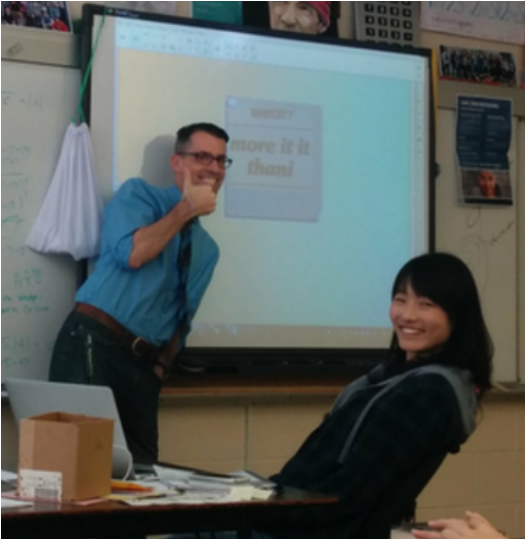
This week's Student of the Week is Subin Y! (this is the only picture I have of her. I'd love a better one...)

Wow! Where to start when it comes to Subin?! She arrived in my class in grade 10 and she has been - quite frankly - one of the highest achieving math students in my class ever since. Subin is a walking testament to the strength of the Korean Mathematics Curriculum. In the past 2.5 years of teaching her, I believe that there has only been one chapter (Sequences and Series in PreCalculus 11) that Subin hadn't already studied in Korea. But here's the thing... while some people would take the attitude "I've already seen this stuff before. I can take it easy.", Subin has never been like this. She always does her best. She always does extra questions. She always gets all her difficulties cleared up. And... not surprisingly... she always does spectacularly well.

Subin is also an incredibly kind and sweet person. Here are two little stories that demonstrate this:
  1. (this story also demonstrates what an idiot I am). A couple of years ago, when Subin had first arrived at KG, I had a great CS student - Otto - working with me (hey, does anyone know whatever happened to Otto?!). I can't remember why but Otto needed to know the translation of some Chinese word. Obviously I couldn't help so - in a moment of "brilliance" - I told him to go ask Subin and Jessica (Subin's cousin!!). He looked at me like I was crazy but I gently encouraged him: "go on, they are really nice. Ask them". So Otto goes over, says something in Mandarin, Jessica and Subin look at him blankly, and he walks back to me. 

    Me: So, how'd it go?
    Otto: They couldn't help.
    Me: They didn't know the word?
    Otto: Nope.
    Me: That's surprising.
    Otto: Not really. They don't speak Mandarin. They are Korean. 

    Noooo!!! To this day, I don't know how or why I did this!! I mean, I'd just "bonded" with Jessica and Subin the previous week when I told them that my sisters are both Korean (adopted when they were babies). And then I do... THAT!!!? Anyway, all three students were so forgiving. I don't think any of them were (too) offended. Subin smiled politely and accepted my apology at the time (I bet these days she would give me some - well-deserved - grief).
  2. As (hopefully) you already know, I often write comments to students on tests and assignments. So I guess for A YEAR AND A HALF (!!!) I had been doing this with Subin. I'd been writing things like: "Great work Su Bin!" and "Another fantastic test, Su Bin!" etc. Well, it turns out I was spelling Subin's name wrong every time. (in my defense, Subin's name was spelled "Su Bin" in the VSB marks program. So that's where I saw and "learned" the wrong way to spell her name). Anyway, it took until half way through grade 11 before Subin finally told me (kindly, patiently, gently) that I'd been spelling her name wrong ever since she started at KG. Again, no hostility. No great offense taken. Just kind of an "FYI" sort of thing. What a forgiving girl, Su Bin... er... Subin is!!! (And great news, Subin!! The brand new marks program has just been released... and your name is spelled correctly in it!!!).
This year, Subin is also one of my CS students (lucky, lucky me!). I must say how impressive it is to be working with Subin. She is very intuitive. She always seems to know exactly what and how I want things done. In fact, sometimes I'll find a moment to come tell her what I want her to do next and she will tell me: "Already did it". And, of course, Subin always does complete and accurate work. She is amazing!

I feel very thankful to have taught you the past three years, Subin. You are an extraordinary student but also a wonderful person. Thank you for always being so committed to doing your best and thank you for being so friendly and good-natured. I don't think I have ever seen you any other way than happy, eager, and pleasant. It's actually quite inspiring. I know you have plans of entering Pharmacy. I can confidently state that you will achieve - and excel - at this goal (and any others you have as well). I wish you well and will remember you very, very fondly!!

Comments are closed.

    P. Wadge

    I am your teacher. Obey me.

    Archives

    June 2021
    May 2021
    September 2020
    August 2020
    July 2020
    June 2020
    May 2020
    April 2020
    March 2020
    February 2020
    January 2020
    December 2019
    November 2019
    October 2019
    September 2019
    June 2019
    April 2019
    March 2019
    February 2019
    January 2019
    December 2018
    October 2018
    August 2018
    July 2018
    June 2018
    May 2018
    April 2018
    March 2018
    February 2018
    January 2018
    December 2017
    November 2017
    October 2017
    September 2017
    August 2017
    July 2017
    June 2017
    May 2017
    April 2017
    March 2017
    February 2017
    January 2017
    December 2016
    November 2016
    October 2016
    September 2016
    August 2016
    July 2016
    June 2016
    May 2016
    April 2016
    March 2016
    February 2016
    January 2016
    December 2015
    November 2015
    October 2015
    September 2015
    August 2015
    July 2015
    June 2015
    May 2015
    April 2015
    March 2015
    February 2015
    January 2015
    December 2014
    November 2014
    October 2014
    September 2014
    August 2014
    July 2014
    June 2014
    May 2014
    April 2014
    March 2014
    February 2014
    January 2014
    December 2013
    November 2013
    October 2013
    September 2013
    August 2013
    July 2013
    June 2013
    May 2013
    April 2013
    March 2013
    February 2013
    January 2013
    December 2012
    November 2012
    October 2012
    September 2012
    August 2012

    RSS Feed

    Categories

    All
    Baby Stuff
    Bikes
    Cats
    Cool Math Stuff
    Crazy Stuff
    Flipped Classrooms
    France / French
    Grade 11's
    Grade 12's
    Grade 8's
    Jokes
    Lovey Dovey Stuff
    Math In The News
    Movies
    Music
    Parent Praise
    Ping-Pong
    Silliness
    Song Of The Week
    Student Of The Week
    Student Praise
    Teacher Praise
    Ties / Clothes
    Words Of Wisdom

Nobody can do it for you...